

 |
 |
 |
 |
|||||||||||||||||||||||||||||||||||||||||||||||||||||||||||||||||||||||||||||||||||||||||||||||
 |
||||||||||||||||||||||||||||||||||||||||||||||||||||||||||||||||||||||||||||||||||||||||||||||||||
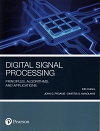 |
Digital Signal Processing 5/e+作者:
Proakis+年份:
2025 年5 版
+ISBN:
9789813354487
+書號:
EE0532P
+規格:
平裝/單色
+頁數:
1168
+出版商:
Pearson(Asia)
+參考資訊:


|
定價
$ |


|
本站購物功能已關閉,點選"購物車"圖示會自動連結到新的購書網頁!或與LINE客服諮詢聯繫
讀者購書請至★滄海書局‧鼎隆圖書購書網 ★https://eshop.tsanghai.com.tw/★
滄海ESHOP購書網提供更方便、快速訂購、結帳付款的購書服務,並提供數位產品購買專區~
書籍若有教學輔助配件,僅提供採用老師教學使用,是非賣品,不販售,亦無法提供一般讀者。

●NEW: Chapter 12 covers multirate digital filter banks and wavelets. It explains the two-channel quadrature mirror filter (QMF) banks and multichannel filter banks that eliminate aliasing and provide perfect reconstruction of signals. It includes treatment of the design of FIR filters for both two-channel and multichannel filter banks. Wavelets and the discrete wavelet transform are the focus in the second part of the chapter, which describes the construction of the discrete wavelet transform and the connections between wavelets and filter banks.
●NEW: ARMA model parameter estimation is included in the detailed examination of power spectrum estimation.
●NEW: Introduces the short-time Fourier Transform and the sparse FFT algorithm in its examination of DFT properties and applications and efficient computation of the DFT.
●NEW: Discusses reverberation filters in its coverage of frequency-domain Analysis of LTI discrete systems.

●Practical applications include examples, over 500 homework problems, and computer problems.
●Describes techniques to convert analog signals, the analysis of linear time-invariant discrete-time systems and signals in the time domain, and bilateral and unilateral z-transform methods.
●Analyzes signals and systems in the frequency domain, the Fourier series and transform in continuous- and discrete-time signals, and the sampling and reconstruction of continuous-time signals.
●Examines realizations of IIR and FIR systems and techniques to design digital filters.
●Looks at sampling-rate conversion and applications to multirate digital signal processing.
●Discusses linear prediction, optimum linear filters and single-channel adaptive filers based on the LMS and RLS algorithms.

Known as a digital communications expert, inspiring educator and prolific writer, John G. Proakis has helped shape electrical engineering and digital communications programs and composed textbooks that have influenced graduate students worldwide. Dr. Proakis developed an outstanding reputation of providing inspired teaching and supervision of students with an academic career that began in 1969 with the Electrical Engineering Department at Northeastern University, MA, USA. As the chair of Northeastern's Department of Electrical and Computer Engineering, Dr. Proakis helped transform the department from a teaching environment to a dynamic research-active department. Dr. Proakis also served as associate dean and director of Northeastern's Graduate School of Engineering. Of his 10 textbooks on digital communication and signal processing, Digital Communications (McGraw Hill) is perhaps the best known. Considered the most influential resource on the topic and now in its 5th edition, the textbook has educated generations of students and engineers about the fundamentals associated with the digital information age. His other influential textbooks include Introduction to Digital Signal Processing (Prentice Hall), Communication Systems Engineering (Prentice Hall) and Fundamentals of Communication Systems (Prentice Hall). Dr. Proakis has also expanded engineering education beyond theory to laboratory experiments and simulation techniques using computers and software. His textbooks in this area include Digital Signal Processing Using MATLAB (CL-Engineering) and Contemporary Communication Systems Using MATLAB and Simulink (Cengage Learning). Through these approachable books, Dr. Proakis has helped expose students early on to the MATLAB development and simulation tool that they will likely need to use throughout their professional careers. Dr. Proakis also served as editor of the 5-volume Wiley Encyclopedia of Telecommunications. An IEEE Life Fellow and recipient of the IEEE Signal Processing Society Education Award (2004), Dr. Proakis is a Professor Emeritus with Northeastern University and an Adjunct Professor at the University of California in San Diego, CA, USA.
Dr. Dimitris G. Manolakis, a senior staff member in the Applied Space Systems Group, joined Lincoln Laboratory at the Massachusetts Institute of Technology in 1999 and has combined an extensive research career with a commitment to education. Dr. Manolakis's work has included the exploration and development of techniques in digital signal processing, adaptive filtering, array processing, pattern recognition and remote sensing. His recent research has focused on algorithms for hyperspectral target detection and modeling of spatio-temporal count data from down-looking sensors. Throughout his career, Dr. Manolakis has been involved in educating future engineers. He has taught undergraduate and graduate courses at the University of Athens, at which he earned a bachelor's degree in physics and a doctorate in electrical engineering; Northeastern University, at which he is an adjunct professor; Boston College and Worcester Polytechnic Institute. In addition, through an in-house technical education program, he conducts courses in digital and statistical signal processing and adaptive filtering to explain fundamental principles and concepts to Lincoln Laboratory staff members embarking on research in these areas. In 2013, Dr. Manolakis was recognized with an IEEE Signal Processing Society Education Award for his dedication to advancing education through the development of curriculum materials, publication of scholarly texts and teaching.
Dr. Manolakis is a prolific writer. He has authored or coauthored more than 135 articles on topics ranging from digital signal processing to hyperspectral remote sensing of chemical plumes to hyperspectral image processing for automatic target detection; these articles have been cited in almost 5000 scientific publications. In addition, he has coauthored 3 textbooks that are widely used in academia: Digital Signal Processing: Principles, Algorithms, and Applications (Prentice Hall, 2006, 4th ed.), which has been translated into 6 languages and cited 41,000 times; Statistical and Adaptive Signal Processing (Artech House, 2005) and Applied Digital Signal Processing (Cambridge University Press, 2011).